

AI search strategy is the foundation of modern SEO in a world where search engines are no longer simple keyword matchers but intelligent systems that understand context, intent, and meaning. As platforms like Google evolve into AI-powered answer engines, businesses must rethink how they create and optimize content to stay visible and competitive. Traditional SEO alone is no longer enough to achieve consistent rankings or meaningful traffic.
In this guide, you will learn what AI search strategy is, why it matters, and how it works in practice. You will also understand how an SEO expert in Bangladesh like Sad Sadman Khan applies this strategy to help businesses improve visibility, authority, and conversions. This approach is designed not only for rankings but also for long-term growth and dominance in AI-driven search environments.
Why AI Search Strategy Matters Today
The Shift from Traditional SEO to AI Search
The transition from traditional SEO to AI search represents one of the most significant changes in the history of digital marketing. In the past, search engines relied heavily on exact keyword matching, backlinks, and basic on-page optimization to determine rankings. However, modern systems now use advanced machine learning models and natural language processing to understand user intent and content meaning at a much deeper level.
Search engines like Google Search no longer simply list results based on keyword density. Instead, they analyze how well content answers a question, how authoritative the source is, and how relevant the information is to the user’s intent. This means content must be written in a way that aligns with real human queries, not just search engine algorithms.
Another major shift is the rise of AI-powered search experiences, where users often receive direct answers without clicking through multiple pages. This reduces the traditional importance of ranking positions and increases the importance of being selected as a trusted answer source. As a result, businesses must now focus on clarity, structure, and depth to remain visible.
Ultimately, this shift means that SEO is no longer just about ranking, it is about being understood and chosen by AI systems. Businesses that fail to adapt will gradually lose visibility, while those who adopt AI search strategies will gain a significant competitive advantage in their industry.
How AI Is Changing Discovery and Rankings
AI is fundamentally transforming how users discover information and how search engines rank content. Instead of typing short keywords, users now ask complete questions or conversational queries, expecting precise and immediate answers. This shift has forced search engines to evolve into intelligent systems capable of interpreting context, intent, and nuance.
AI systems such as ChatGPT and Google’s generative search experiences rely on high-quality content that is structured, factual, and contextually rich. These systems do not simply rank pages, they extract and synthesize information from multiple sources to provide the best possible answer to a user’s query. This means that your content must be optimized not just for visibility but for inclusion in AI-generated responses.
Ranking factors have also evolved significantly. While backlinks and domain authority still matter, they are no longer the only deciding factors. AI systems prioritize:
- Content clarity and structure
- Contextual relevance and depth
- Entity recognition and authority
- User satisfaction signals
This shift places a strong emphasis on content quality and structure. For example, well-organized content with clear headings, concise explanations, and structured data is far more likely to be selected by AI systems than unstructured or shallow content.
As a result, AI is not just changing search rankings, it is redefining what it means to rank at all. Being visible in AI search results requires a completely new approach to SEO, one that prioritizes meaning, authority, and usability.
What This Means for Your Business Growth
The impact of AI search strategy on business growth is both direct and long-term. First, it significantly increases your visibility across modern search platforms, including AI-powered tools and answer engines. When your content is optimized correctly, it has a higher chance of being featured in AI-generated responses, which can dramatically increase brand exposure.
Second, AI search strategy improves the quality of your traffic. Instead of attracting random visitors, you attract users who are actively searching for solutions, services, or products related to your business. These users are already in a decision-making mindset, which leads to higher engagement and conversion rates.
Third, it strengthens your brand authority. When AI systems consistently reference your content as a reliable source, it builds trust and credibility in your niche. This authority compounds over time, making it easier to rank for competitive keywords and dominate your industry.
Finally, AI search strategy creates long-term sustainability. Unlike paid advertising, which stops generating results once the budget is exhausted, AI-optimized content continues to perform and generate results over time. This makes it one of the most cost-effective and scalable growth strategies available today.
What Is an AI Search Strategy?
An AI search strategy is a structured and intentional approach to optimizing content for AI-driven search systems. It goes beyond traditional SEO by focusing on how artificial intelligence interprets, understands, and ranks content based on meaning, context, and authority rather than just keywords.
This strategy ensures that your content is not only indexed by search engines but also selected and used as a source of truth in AI-generated responses. It involves aligning your content with how users search, how AI processes information, and how search engines evaluate credibility and relevance.
A strong AI search strategy integrates content creation, technical optimization, and authority building into a unified system. This system helps businesses position themselves as experts in their niche while ensuring their content remains visible across evolving search platforms.
Core Principles of AI Search Optimization
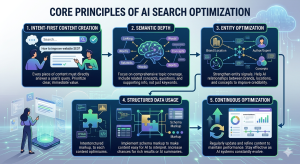
AI search optimization is built on several core principles that guide how content should be created and structured. The first principle is intent-first content creation, which means every piece of content must directly answer a user’s query. AI systems prioritize content that provides clear and immediate value.
The second principle is semantic depth. Instead of focusing on repeating keywords, content must cover a topic comprehensively by including related concepts, questions, and supporting information. This helps AI understand the full context of the content.
The third principle is entity optimization. Entities such as brands, locations, and concepts help AI systems understand relationships between topics. Strengthening entity signals improves your content’s credibility and visibility.
The fourth principle is structured data usage. By implementing schema markup, you make it easier for AI systems to interpret your content accurately. This increases the chances of your content being featured in rich results or AI summaries.
Finally, continuous optimization ensures your strategy remains effective over time. AI systems evolve constantly, so your content must be regularly updated and refined to maintain its performance and relevance.
AI Search vs Traditional SEO
AI search and traditional SEO differ significantly in both approach and outcomes. Traditional SEO focuses on ranking web pages for specific keywords using techniques such as backlink building, keyword optimization, and on-page SEO. While these methods are still important, they are no longer sufficient on their own.
AI search, on the other hand, focuses on delivering answers rather than ranking pages. AI systems evaluate content based on its ability to provide accurate, relevant, and well-structured answers to user queries. This means that content quality and clarity are more important than ever.
Tools like Ahrefs and SEMrush are still valuable for research and analysis. However, they must be used alongside AI-focused strategies that prioritize intent and context. The goal is not just to rank higher but to become the best possible answer.
Key Ranking Factors in AI Systems
AI ranking systems use a combination of factors to determine which content to display. These include content relevance, authority, structure, and user engagement. Content that clearly answers a question and is easy to understand is more likely to be selected.
Another important factor is authority. AI systems prefer content from sources that demonstrate expertise and trustworthiness. This is why EEAT signals are critical in AI SEO.
Structured content also plays a major role. Well-organized content with headings, lists, and clear formatting is easier for AI systems to process and extract information from.
Finally, user engagement signals such as time on page, click-through rate, and interaction also influence rankings. These signals help AI determine whether users find the content useful and relevant.
For more information on ranking systems, you can refer to Google Search Central.
Sadsadman Khan’s AI Search Strategy Framework
Sad Sadman Khan’s framework is designed to help businesses systematically improve their visibility in AI-driven search systems. It focuses on practical, results-driven steps that align with how modern AI search works.
AI Visibility Audit
The AI visibility audit is the first step in understanding how your brand currently performs in AI search environments. This involves analyzing where your content appears, how it is being interpreted, and where gaps exist.
The audit includes evaluating your existing content, identifying missing opportunities, and understanding how competitors are performing. This gives you a clear roadmap for improvement and helps prioritize actions that will deliver the highest impact.
Entity & Authority Optimization
Entity and authority optimization focuses on strengthening your brand’s presence in AI systems. This involves building consistent mentions, improving structured data, and reinforcing topical authority.
By optimizing entities, you help AI systems better understand your brand and associate it with relevant topics. This increases your chances of being selected as a trusted source.
Content Designed for Answer Engines
Content must be designed specifically for AI systems. This means writing clear, concise answers that directly address user queries. It also means using structured formatting such as headings, bullet points, and FAQ sections.
This type of content is more likely to be extracted and used by AI systems, increasing your visibility and authority.
Continuous Optimization System
AI search is constantly evolving, which means your strategy must evolve as well. Continuous optimization involves regularly updating content, analyzing performance, and refining your approach.
This ensures that your content remains competitive and continues to perform over time.
AI Search Strategy Services
AI SEO Audit
Visibility & Gap Analysis
This identifies how visible your content is and where improvements can be made to increase performance.
Competitor Benchmarking
This compares your performance against competitors to uncover opportunities for growth.
AI Content Strategy
Topic Clustering
This organizes content into related groups to build authority and improve SEO performance.
Search Intent Mapping
This ensures your content aligns with what users are actually searching for.
AI-Optimized Content Creation
Blog & Landing Page Optimization
This focuses on creating high-quality, optimized content that ranks and converts.
Conversion-Focused Copy
This ensures your content not only attracts visitors but also turns them into customers.
Technical & Entity SEO
Schema & Structured Data
This helps search engines understand your content better.
Site Architecture Optimization
This improves navigation and indexing.
How the AI Search Optimization Process Works
The process begins with an audit to identify opportunities and gaps. This is followed by strategic planning, where a customized roadmap is created based on your goals.
Next comes execution, where optimization techniques are implemented across your content and website. Finally, tracking and improvement ensure continuous growth and performance.
Results You Can Expect
AI search strategy delivers measurable results, including increased visibility, higher-quality traffic, stronger authority, and improved conversions. Over time, these results compound, leading to sustained business growth.
Proof of Results
Case studies and testimonials demonstrate the effectiveness of this strategy. Real-world examples show how businesses have improved rankings, traffic, and revenue through AI search optimization.
AI Search Insights & Resources
This section provides insights into trends, guides, and industry knowledge to help you stay ahead in AI search optimization.
Frequently Asked Questions
What is AI search strategy?
AI search strategy is a modern approach to SEO that focuses on optimizing content for AI-driven search systems. It prioritizes intent, structure, and authority to ensure content is selected as a trusted answer. This strategy is essential for staying visible in evolving search environments and improving long-term performance.
How is AI SEO different from traditional SEO?
AI SEO focuses on context, meaning, and user intent, while traditional SEO focuses on keywords and backlinks. AI systems analyze content more deeply, making clarity and structure more important than ever. This shift requires a more strategic and comprehensive approach to content creation and optimization.
How long does it take to see results?
Results depend on your current website strength, competition, and implementation quality. Typically, you can expect noticeable improvements within three to six months. However, AI search strategy is a long-term investment that continues to deliver value over time.
Can AI replace SEO experts?
AI cannot fully replace SEO experts. While it can assist with research and content creation, human expertise is required for strategy, creativity, and decision-making. A skilled SEO professional ensures that your strategy aligns with business goals and delivers measurable results.
Do I need a new website for AI search?
No, you do not need a new website. Instead, you need to optimize your existing site with AI-friendly content, structured data, and strong internal linking. A well-optimized website can perform effectively in AI search systems without requiring a complete rebuild.
Let’s Build Your AI Search Strategy
If you want to improve your visibility, attract qualified traffic, and grow your business, now is the time to act. An AI search strategy gives you a competitive advantage in an evolving digital landscape.
Book a strategy call, get a custom plan, and start optimizing your presence today. For expert guidance, visit https://sadsadmankhan.me/i-will-create-your-ai-search-strategy/ and take the next step toward AI-driven growth.